

STEMxLearning • November 18, 2025
I realised this one day while watching a kid scroll through YouTube.
No excitement. No surprise. Just swipe, tap, skip.
The next video appeared. Then another. And another — all somehow exactly what they wanted to watch.
No one had explained anything to them.
They didn’t ask why it worked.
They didn’t question how the app knew.
It just did.
And that’s when it hit me: children are already living with AI, but no one ever tells them that’s what it is.
When we hear the words Artificial Intelligence, our minds jump to extremes. Robots. Machines taking over jobs. Something futuristic and slightly scary. But real AI isn’t dramatic at all.
It’s quiet.
It blends in.
It hides inside ordinary moments.
For example:
Things kids use without a second thought, without even naming it.
A child doesn’t think, “I’m using AI today.”
They just play a game that somehow becomes harder when they start winning.
They ask a question out loud and expect an answer.
They unlock their phone with their face like it’s the most normal thing in the world.
And maybe that’s the strangest part — how normal all of this feels.
What worries me a little isn’t that kids use AI. That part is unavoidable now. It’s that they grow up thinking technology just happens.
Like magic.
They don’t see the people behind it.
They don’t realise that someone made decisions:
They don’t question whether technology can be wrong.
So when something doesn’t work, many kids don’t blame the system.
They blame themselves.
That’s a heavy belief to carry, especially at a young age.
When in reality, confusion is normal.
Especially with technology.
Especially with learning.
If you explain AI to a child in simple words, it doesn’t sound scary at all.
It’s just a computer that learns by looking at examples.
The more examples it sees, the better it gets.
That’s it.
No feelings.
No thinking like humans.
Just patterns.
Because no one explains this early, kids react in two unhealthy ways:
Neither reaction comes from the child.
It comes from silence.
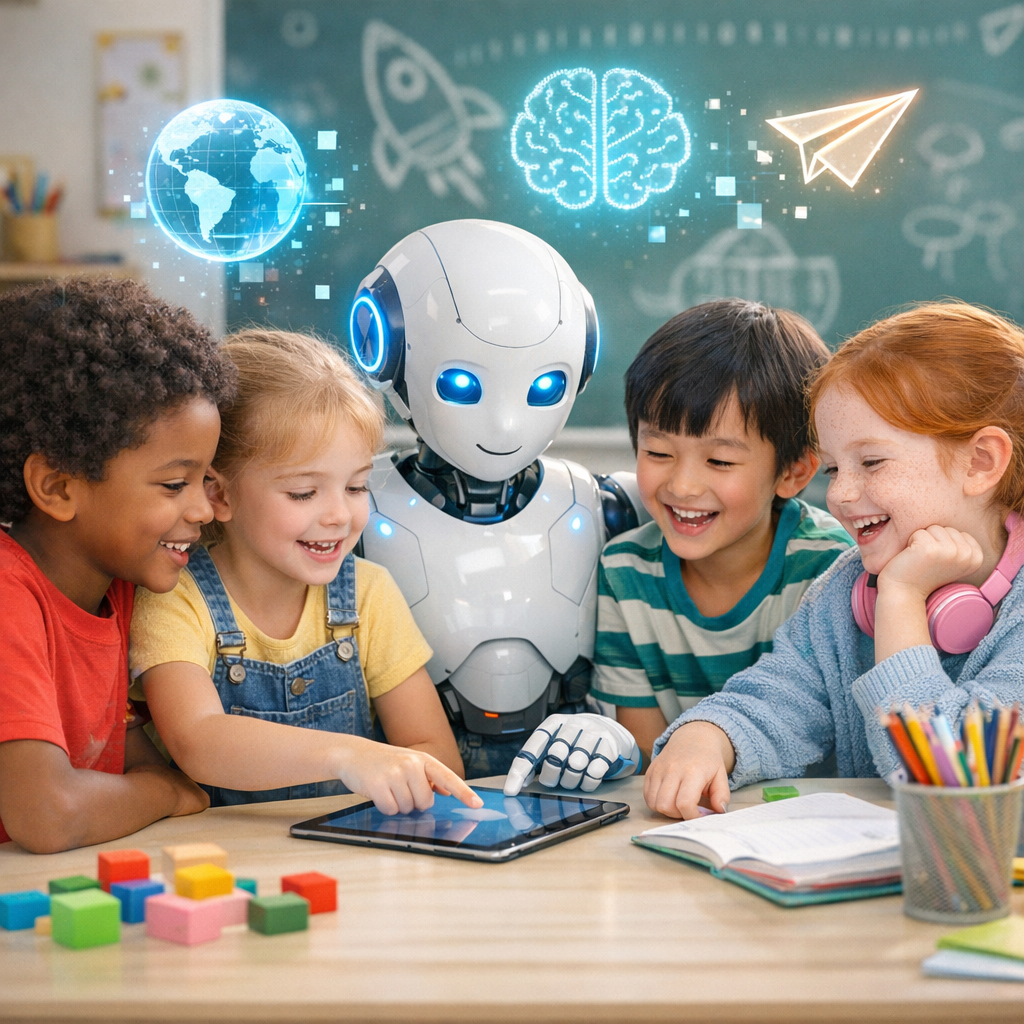
What I actually like about AI learning is how un-school-like it can be.
Kids train a computer to recognise drawings.
They make it guess animals.
They build tiny chatbots that give funny, unexpected answers — and laugh when it gets things wrong.
Mistakes don’t feel embarrassing here.
They feel interesting.
That’s such a contrast to regular classrooms, where mistakes often mean red marks, lost confidence, or quiet embarrassment.
In AI learning, mistakes are part of the process.
You expect them.
You learn from them.
You move on.
Parents often think AI is “too advanced” for children. Too complicated. Too technical.
But kids don’t think like that.
They don’t ask, “Is this advanced?”
They ask, “Is this fun?”
And when learning feels playful, curiosity shows up naturally.
Over time, that curiosity turns into understanding. Slowly. Quietly. Without pressure or fear.
There’s also something important kids need to learn early:
It only repeats what it has learned from data — good data or bad data.
Teaching this early helps kids not blindly trust everything a machine says.
It helps them stay thoughtful.
Responsible.
Using AI to learn is helpful.
Using AI to replace thinking is not.
That difference is subtle, but it matters more than we realise.
And honestly, parents don’t need to be experts to guide their children through this.
Sometimes all it takes is a simple question:
Those questions stay with a child.
They plant seeds.
Kids today are growing up with AI whether we like it or not.
The real choice is whether they grow up aware of it — or just surrounded by it.
Aware kids don’t feel afraid of technology.
They don’t feel small around it.
They don’t feel like it’s out of reach.
They feel curious.
And curiosity, honestly, is the best place to start.